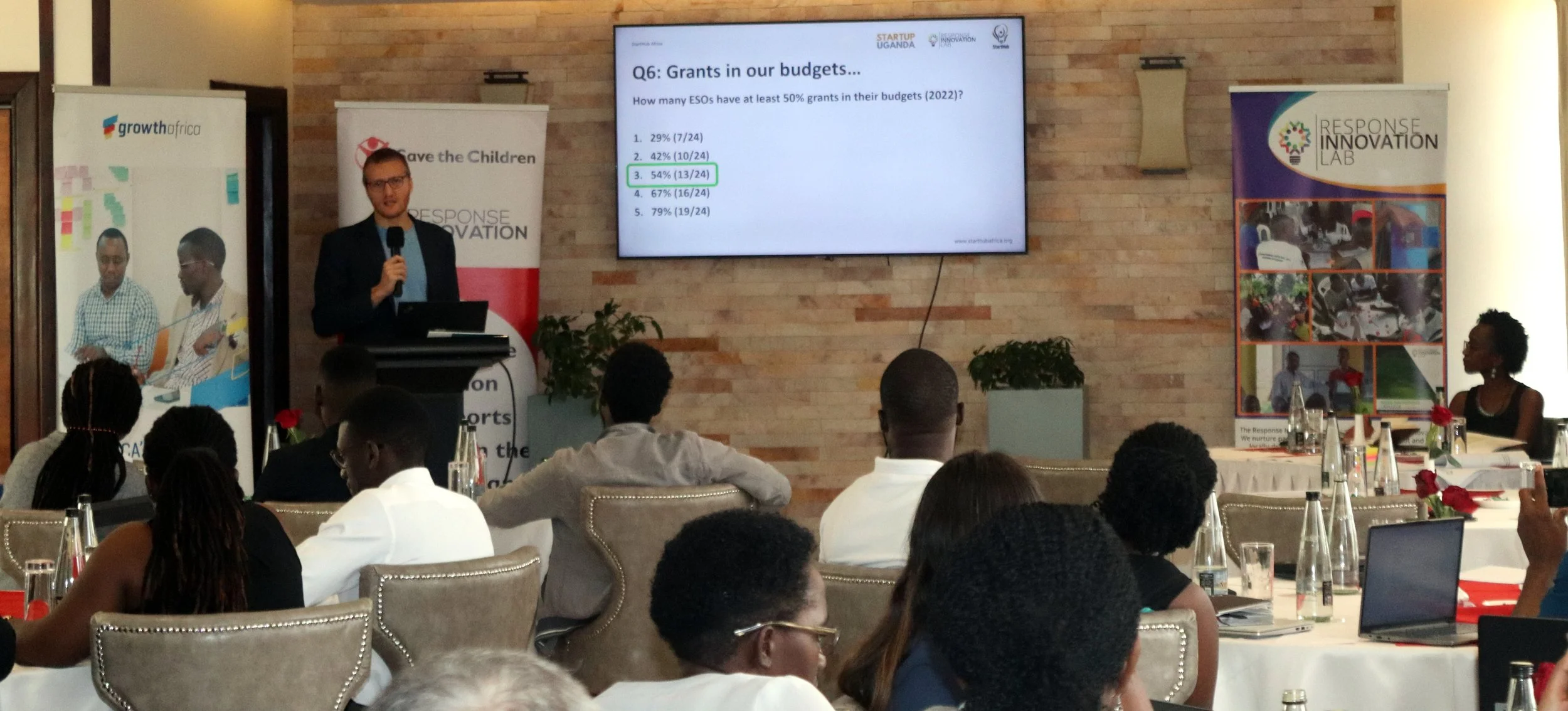
U-RIL hosts launch event for Entrepreneurship Support Organizations (ESOs) landscape analysis
On Friday, 29 September 2023, Uganda's Response Innovation Lab (U-RIL), in partnership with Startup Uganda, hosted an event to disseminate the findings of the Landscape Analysis of the Uganda Innovation Ecosystem and to launch SMILE, an interactive ecosystem map.

RILx23 Perspectives: Reflections on Humanitarian Innovation - Navigating New Frontiers, Partnerships, and Impact
Dear humanitarian innovators and innovative humanitarians,
I hope that this blog post finds many of you enjoying a well-earned vacation. Leaving your day to day surroundings has a way to elicit some fresh thinking and gain some perspective on things, no? In my case, the change of perspective is quite literal:

RILx23 Unveils Promising Outcomes and Strategic Insights
We are thrilled to share the remarkable outcomes of RILx23, the annual event organized by Response Innovation Lab (RIL), which took place in Nairobi last week. RILx23 served as a vibrant platform that brought together diverse stakeholders from the Response Innovation Lab network, alongside selected global and regional humanitarian innovation actors.

Refugee-led Innovations in Uganda: the Innovations we Need
In Uganda, refugee-led organizations (RLOs) are developing innovative solutions to everyday problems found throughout their settlements and host communities. In this blog post we shine a spotlight on 13 RLOs creating, testing, and providing new solutions for refugees and others.

Learning from a savings group digitisation pilot in Uganda
Financial inclusion efforts and savings groups are common interventions in humanitarian and development programming. Individually or combined they help promote savings, increase access to credit and ultimately, build self-reliance. With more commercial and mainstream financial services moving online, there are also efforts to do the same at the community level. With this in mind, Ugandan company Akaboxi developed a way to help digitise village savings and loan associations (VSLAs) and link them to banks and other finance institutions. Akaboxi hoped their innovation would not only help people save but also help them build a base from which they could access commercial financial services in the future.

Boosting interest in open source in Uganda
Starting around May 2022, RIL and Audiopedia Foundation ran three interactive events in Kampala. These events also included developing interesting case studies of open source in action and running a contribution competition. Through these events it was hoped that existing open-source users and developers would find humanitarian and development actors to partner with and that more people, regardless of their background, would feel more confident to try using open-source software.

Scale-up: Electronic Medical Record
In early 2021, the initial pilot between WV and OGOA Health concluded at the two targeted health facilities. However, the system continues to operate, and eventually funding was secured to expand the system to connect a total of 15 health facilities. MOUs were also signed with the Puntland Ministry of Health, endorsing the system.

The Journey So Far
Five years ago, Response Innovation Lab launched its first platform in Jordan, kicking off an adventure that continues to prove exciting and essential to this day. To mark this milestone and the start of a new phase in our initiative, we wanted to share with you some of the most noteworthy accomplishments of our amazing colleagues and partners. Together, we have grown RIL into the largest network of field-based humanitarian innovation platforms in the world and have collectively demonstrated that decentralizing innovation processes, strengthening response-level ecosystems, promoting locally-developed solutions and encouraging horizontal scaling can improve humanitarian and “nexus” programming while also delivering on the promises of the Grand Bargain.

Local Innovations for Nutrition Solutions (LINS)
With the LINS project, RIL Uganda identified alternative solutions to the traditional distribution of free and imported nutritious foods (corn-soya blend/porridge) through a participative and competitive process.
Learn more about LINS here

In honor of World Refugee Day, check out these innovations...
Our labs are supporting several innovations that directly benefit refugee populations, learn more about these innovators and their pursuit to support their communities and others.

Op-Ed: The Rescuers - How emergencies turn local resources into transformative assets.
While this pandemic is not without precedent in human history, the novel coronavirus is, as it has fundamentally disrupted and changed our global systems. From history, we learn that during difficult and challenging times, the world and our communities innovate in unique and interesting ways. The stories that come to mind now are more of ad-hoc solutions to very immediate dangers. These tales of quick thinking and decisive action, as well as their aftermath, draw better parallels with the present that can help us see a new way forward.
![Lessons learned on integrating innovation into the Uganda refugee response [ Devex ]](https://images.squarespace-cdn.com/content/v1/5d7fba1a7dc0f278f09832df/1614028911010-3MF2E7RPR6RF15YPAE6B/IMG_20200218_104759.jpg)
Lessons learned on integrating innovation into the Uganda refugee response [ Devex ]
As originally published on Devex (10 Feb 2021) - Through the establishment of RIL in Uganda, our team has learned a few lessons on integrating innovation into the humanitarian context that we are sharing in a supportive effort around localization.

RIL & The Humanitarian Grand Bargain
A founding principle to RIL has always been the focus on strengthening local ecosystems to build resiliency and contextualized support for the response.

RIL's work in Iraq and Uganda highlight in DIIS's COVID-19 Report
The Danish Institute for International Studies (DIIS) produced a report in November 2020 on the future of technology and innovation from the COVID-19 response. The Response Innovation Lab’s both in Iraq and Uganda were highlighted.

The Refugee Engagement Forum in Uganda as an innovative approach to AAP
The REF is an innovative Accountability to Affected Populations (AAP) mechanism in the Uganda refugee response. The study showcases REF as a good practice for community engagement in a refugee response setting and hopes to inspire other countries to do the same and attracting more support for the REF in the country.

Innovation During Crisis
The world is counting on innovations in virology, epidemiology, and other medical fields to deliver a vaccine for the novel Coronavirus and treatment for Covid-19. These breakthroughs are likely to be made in labs from the world’s leading economies. However, there is a critical second tier of issues whose solutions are already emanating from much more diverse contexts. NGOs in resource-poor settings are trying new methods of sharing information through multi-media channels and new forms of content. While these types of innovation may not lead to a cure for the disease, they are addressing critical problems in its transmission and spread; in addition to the direct implications of this pandemic, the long-term impact on the well-being of individuals remains obscure and will inevitably add another layer of challenge to people’s lives

Partnership Potentials: Investigating Uganda business attitudes to partnerships with INGOs to co-create community-based innovations
Written by Jodi Ashley Fleming, University of Copenhagen.
Collaborative private sector-INGO partnerships allow both organizations to combine their valuable expertise and create contextual innovative solutions for a humanitarian and community-based response; something more essential than ever as new types of crises emerge globally. This qualitative study investigated Ugandan private sector attitudes towards partnerships with INGOs to co-create community-based innovations.

Building Evidence for Scaling
Research conducted by Fiona Mwenda and Lydia Tanner at The Research People for the Response Innovation Lab.
The paper begins with a short discussion of what we mean by scaling and why it is not appropriate for every innovation to scale. The paper then outlines the different types of evidence that are important to different audiences, and some of the factors that innovators should consider in prioritizing evidence.

World Refugee Day: How innovation is solving access to financial services for refugees in Uganda
A challenge faced by many refugees and rural community members in Uganda is the safety of saving money and the opportunities to access loans. Refugees frequently do not have access to banks, nor are they able to open bank accounts due to a lack of credit history or collateral. Not having a secure place to store money, makes saving challenging and risky. Akaboxi is tackling these problems straight on and transforming opportunities for financial service providers across Uganda.