
“Made by ______”
“Made by ___” is a project model designed by RIL, successfully piloted through its "Made by Syrians" edition and now extended with the recently launched "Made by Yemenis" edition.
Rather than positioning the local communities as implementers of externally designed interventions, the initiative creates a platform for the local innovators of the chosen context—inside the context and across the diaspora—to lead the design and development of solutions to humanitarian challenges, bridging entrepreneurial thinking with humanitarian needs. Rather than supporting isolated projects, the initiative builds a network, shares learning, and creates pathways for ideas to be tested, adopted, and scaled—contributing to a stronger local innovation ecosystem.
-
The Challenge
Across humanitarian and crisis-affected settings, some of the most relevant and effective solutions often emerge from the communities living through the crisis themselves, as innovation developed by local entrepreneurs, civic innovators, youth, women's networks, and diaspora groups tends to respond better to urgent needs, being deeply rooted in the lived realities, constraints, and priorities of affected populations. Yet despite a growing sector-wide commitment to localisation, a fundamental disconnect remains: local actors are still largely positioned as recipients, implementers, or consultation stakeholders of externally designed solutions, lacking sufficient ownership to drive systemic influence, and many promising local solutions remain "invisible" to funders and decision-makers who could help validate, adopt, and expand their impact. This is compounded by the project-based nature of humanitarian support, with mechanisms often confined to short-term grant cycles and limited technical assistance, lacking a systemic approach to ecosystem building, evidence generation, or pathways for scale and replication: risking a cycle in which external interventions continue to dominate while homegrown solutions with strong sustainability and scaling potential remain underutilised.
Taken together, these dynamics reveal a critical systemic gap: the humanitarian sector lacks strong, response-based platforms that enable crisis-affected and diaspora communities to not only generate solutions, but also connect with support networks and structure, growth pathways, funding mechanisms, decision-makers, and evidence and learning systems that can enable adoption, scale, and meaningful long-term impact.
-
Our Solution
RIL proposes an Open Challenge call combined with customized, stage-by-stage innovation mentoring to enable local knowledge to address local challenges in line with response priorities. This initiative calls on innovators from the affected communities and the diaspora networks to submit innovations at any stage—from ideation to scaling—and aims to connect those with deep contextual knowledge to the systems that can validate, fund, and scale their solutions. In doing so, it seeks to expand access to effective, locally grounded solutions while contributing to a consolidated, ecosystem-wide platform for actors to connect and share learning.
The proposed initiative directly builds on the proven framework of “Made by Syrians” program, which Syria Response Innovation Lab has successfully delivered with World Vision Syria Response. This initiative has demonstrated RIL’s ability to:
Surface and support Syrian-led innovations across Education, WASH, and Climate Adaptation;
Provide tailored coaching, mentoring, and technical support to selected innovators;
Connect the selected innovators to global decision-makers and potential funding opportunities through high-visibility Pitching Webinar;
Curate dedicated communication materials and social media content for enhanced global visibility and continuous engagement.
How does the process look like?
-
1. Design & Ecosystem Mapping
The phase focuses on preliminary research to help ensure the challenge is grounded in local realities and address critical gaps. Before the launch of the Open Call, RIL will conduct a focused research to identify priority problem areas to help scope the sectoral focus of the Open Call that reflect urgent needs and actual demand for solutions. For example, RIL’s Made by Syrians initiative identified WASH, Climate Change Adaptation, and Education as thematic focus areas, defining the scope of innovations sought through the Open Call.
-
2. Open Call Launch
The Open Call will be addressed to existing innovators from both the affected communities and the diaspora groups. The purpose is to identify promising solutions, providing equitable access to innovation support resources. The Open Call will be structured as questionnaires designed to assess the feasibility, affordability, potential impact and sustainability of the solution, as well as the innovator’s ability to drive scaling. Applicants will be asked to submit evidence of their solution development and impact supporting their applications.
-
3. Selection & Tailored Innovation Support
The applications will be reviewed and assessed against criteria including relevance to the thematic focuses, innovativeness, feasibility, and potential for impact. RIL will lead the formation of a diverse, multidisciplinary selection committee consisting of local experts, technical specialists, and humanitarian practitioners to shortlist applicants for interviews or pitching sessions. The tailored innovation support includes technical support, mentorship, and visibility support.
-
4. Showcase & Connection
RIL will connect innovators with the resources and networks needed to further advance their innovations during this phase. RIL will organise a Pitch Day or Pitching Webinar for selected innovators to showcase their solutions to a targeted audience of UN agencies, humanitarian INGOs, donors, and private sector partners, etc. All pitches will be recorded and circulated across RIL’s communication channels, creating matchmaking opportunities to help innovators reach potential partners and funding sources. There will also be additional, tailored support such as meeting facilitation, flexible funding support, etc. depending on the final program design.
-
5. Continuous Engagement & Ecosystem Integration
RIL strives to extend impact beyond the project cycle by providing ongoing support to selected innovators. Participants will join an alumni network for continued visibility opportunities and will be invited to collaborate with the global RIL network to document and share lessons learned throughout their innovation journey, facilitating cross-context learning. Through sustained engagement and facilitated connections, RIL reinforces its ecosystem approach—strengthening innovation networks and ensuring that local solutions remain visible, connected, and positioned for long-term growth.
Current & Past Projects
“Made by Yemenis” has attracted a wider partnership, implemented under the Humanitarian System Transformation through Local Humanitarian Leadership (HST-LHL) program led by Oxfam, in partnership with Response Innovation Lab (RIL) and implemented by CPS Foundation for Development.
The initiative seeks to support innovative ideas and projects tackling WASH and Climate Adaptation challenges in Yemen through technical capacity sharing support and funding. The project was launched in July, 2026 and is ongoing.
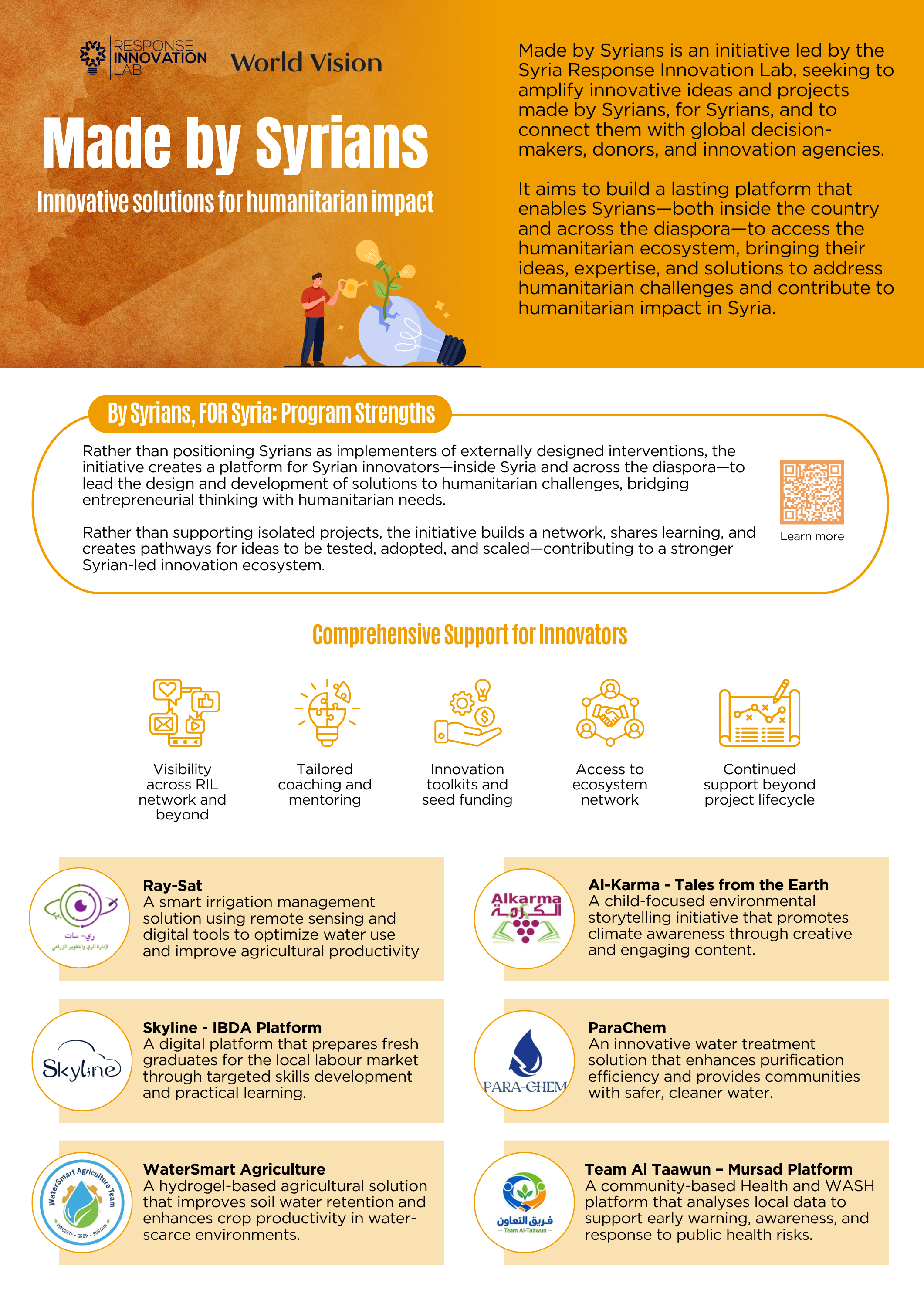
Made by Syrians is an initiative led by the Syria Response Innovation Lab, seeking to amplify innovative ideas and projects made by Syrians, for Syrians, and to connect them with global decision-makers, donors, and innovation agencies.
It aims to build a lasting platform that enables Syrians—both inside the country and across the diaspora—to access the humanitarian ecosystem, bringing their ideas, expertise, and solutions to address humanitarian challenges and contribute to humanitarian impact in Syria.