
Big Ideas, Hard Realities: Youth Perspectives on Innovation in Crisis Contexts
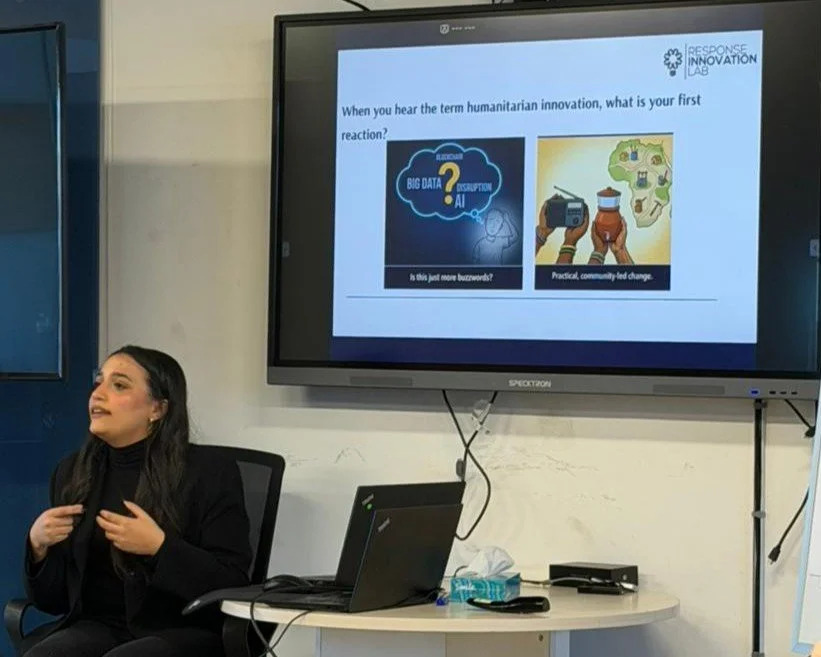
The session was designed and led by our Innovation Fellow, Rajaa Jamaani.
On Wednesday, March 11, 2026, the Response Innovation Lab (RIL) hosted a Thoughtcast session in Amman, Jordan, bringing together Lazord Fellows for a reflective discussion on how innovation is understood and practiced in crisis contexts through youth perspectives. The session created a space for young professionals working across humanitarian response, refugee support, youth empowerment, healthcare, and education to exchange insights drawn from their professional experiences and engagement with crisis-affected communities.
Innovation has become one of the most frequently used terms in the humanitarian sector, often presented as a key pathway to addressing complex challenges in crisis-affected settings. Yet the growing prominence of the term has also raised important questions: when we speak about innovation in humanitarian contexts, what does it actually mean in practice? The Thoughtcast session provided an opportunity for fellows to reflect critically on this question. The youth perspective complements the existing sector discussions, and the diversity of professional backgrounds among participants enriched the discussion, bringing forward a wide range of perspectives on how innovation is interpreted, applied, and sometimes constrained within humanitarian systems.
Participants emphasized that meaningful innovation is often less about grand ideas and more about practical, community-led solutions that emerge as communities adapt to crisis conditions. In this sense, innovation was framed not as an abstract concept, but as an adaptive mindset and a process grounded in local realities. The discussion also surfaced different perspectives on the relationship between innovation and the lived experiences of communities in crisis. While many fellows highlighted that communities themselves frequently generate the most relevant and adaptable solutions, others noted that in moments of acute crisis—when individuals are primarily focused on survival—the space for experimentation and innovation can become limited. Drawing on reflections related to Maslow’s hierarchy of needs*, participants highlighted how people often prioritize meeting basic needs first. At the same time, several fellows challenged the notion that innovation is a luxury, suggesting instead that it can function as a practical tool that helps make everyday life easier and more manageable in difficult circumstances.
Participants also discussed systemic challenges that can limit the emergence and adoption of innovative solutions. Fellows pointed to barriers related to localization, noting that some proposed innovations are not always grounded in a deep understanding of community realities. Others highlighted bureaucratic and hierarchical decision-making processes within humanitarian systems, which can slow down response efforts and limit the flexibility required in rapidly evolving crisis settings. Fellows working in the healthcare sector emphasized that innovation in health interventions requires the direct involvement of doctors and health professionals to ensure that new approaches remain safe, ethical, and grounded in medical expertise. Meanwhile, fellows working in the education sector highlighted the importance of safeguarding considerations and the sensitivity required when introducing new ideas in learning environments, particularly when working with children and young people.
By bringing together youth practitioners from diverse sectors, the Thoughtcast created space for deeper reflection on how the next generation of practitioners understands innovation within humanitarian work. Youth perspectives are particularly important in this space, as young professionals often work closely with communities and bring forward grounded insights into emerging needs and locally relevant solutions. The discussion highlighted the importance of grounding innovation not only in new ideas, but in context, community knowledge, and the practical realities faced by people living through crisis.
The session reinforced that innovation in humanitarian contexts is not simply about introducing new solutions, but about understanding systems, listening to communities, and adapting approaches to the realities on the ground.
*Maslow’s hierarchy of needs is a psychological theory that organizes human needs into a hierarchy, starting from basic needs such as food and safety, and progressing toward higher-level needs like belonging, esteem, and self-actualization.