
Synthesised Insights | HNPW 2026: Humanitarian Innovation Past, Present, and Future
Ten years ago, the World Humanitarian Summit placed innovation more centrally in discussions on humanitarian reform and the future of the sector. Around the same time, initial conversations began on creating a global network of field-based innovation facilitators focused on response-level needs and ecosystem development—marking the beginning of the journey of the Response Innovation Lab (RIL). Through the lens of RIL’s ten-year journey to 2026, this Humanitarian Networks and Partnerships Week session reflected on the evolution of humanitarian innovation and surfaced emerging trends shaping a future in which innovation can better deliver on its promises for the sector.
The discussion was anchored in the conceptual foundations and continued relevance of the RIL model: response-level ecosystem building, supporting innovation as a public good within the humanitarian system, and promoting early adoption rather than focusing solely on invention. It explored several key themes and put forward clear calls to action for the wider ecosystem, inviting participants to consider the humanitarian innovation space as one that continues to evolve—and one that still holds significant, yet largely unrealised, potential.
Navigating system constraints in humanitarian innovation
Reflecting on the outset of RIL, one of the challenges was “building for adoption”. In the humanitarian response following the 2015 Nepal earthquake, what was missing was not necessarily ideas or solutions, but a local mechanism that could convene actors, enable collective decision-making, and mobilise local resources for a more coordinated response.
Constraints are not only external—they are often embedded in the innovation process itself. In humanitarian contexts, delivery becomes a design constraint. The system tends to prioritise implementers—those delivering services and goods—while placing less emphasis on the support functions that enable innovation ecosystems to thrive. This creates structural constraints for actors such as RIL which was positioned to facilitate collaboration, validation, and learning rather than directly implement programmes. RIL navigated such constraints by working with early adopters willing to experiment and recognise the value in innovation quickly. Engaging coordination platforms such as cash working groups in Uganda helped demonstrate the practical role of ecosystem facilitation, gradually building credibility and wider acceptance.
From an innovator’s perspective, addressing these systemic bottlenecks also requires structural enablers. For example, adoption financing to support the first deployment of solutions; “validation as a service” to expand the user base for local innovators; and procurement reforms that create fairer opportunities for locally developed private-sector solutions. Together, these measures help innovators move beyond pilot stages and more effectively navigate the system constraints of humanitarian systems.
The relevance of RIL model today and lessons learned to share with other “ecosystem enablers”
The conceptualization of RIL was guided by “problem first, solutions later.” Focusing on clearly defined problems where meaningful impact can be created helps avoid the “shiny object syndrome” that often accompanies innovation discussions. Equally central to this approach is local ownership, which contributes to sustainability of the solutions especially in emergency contexts.
RIL also made conscious efforts to guide projects to “fail responsibly” through, for example, ethics checklists that help innovators anticipate and avoid unintended harm to communities. In addition, there was also emphasis on knowledge generation, creating learnings for the wider sector. The RIL model responds to a persistent challenge in humanitarian innovation: fragmentation. While convening actors remains important, participants emphasised that the next step is moving towards structural adoption brokerage—actively supporting the pathways through which innovations move from pilots to sustained use. This raises practical questions that innovation ecosystems must increasingly address: Who funds the first deployment? Who validates a solution? Who champions its integration within existing systems? RIL is perceived by many as an innovation enabler, convening diverse actors to build consensus and align these roles across the ecosystem.
Looking ahead, several calls to action emerged for innovators and ecosystem enablers alike. These include exploring alternative financing instruments that support adoption and scale; working towards a transformational approach in which communities themselves become the drivers of solutions, building on their inherent strengths; and expanding access to digital public goods, fully utilizing the existing digital infrastructure and tools with lowered costs, etc. Underpinning these shifts is a broader imperative to challenge and move beyond colonial mindsets that continue to shape how innovation and expertise are understood and even deployed within the humanitarian sector.
A more collaborative ecosystem for more effective support for humanitarian innovation
For humanitarian innovation to deliver its promises and meaningful impact, scaling pathways must be intentionally designed, otherwise many promising innovations can only remain as prototypes. In many cases, it is the distribution mechanism—rather than the innovation itself—that ultimately determines impact. When innovations can be embedded within local systems, they are also less dependent on donor funding and more likely to sustain..
While global convenings can help set direction, field execution makes the impact happen. Effective innovation support therefore begins with understanding the context: the available resources, existing infrastructure, and the potential “opportunity to market” for solutions. Within this process, trust functions as the infrastructure of ecosystem collaboration. The sustainability of an innovation is rarely determined by the technology alone, but by the relationships and partnerships that support it over time.
A stronger humanitarian innovation ecosystem also calls for deeper engagement with the private sector, both locally and internationally. Private-sector actors can often drive innovation more sustainably in humanitarian contexts, as market incentives help solutions endure beyond project cycles. At the same time, government support and adoption can provide legitimacy and open pathways for institutional integration. Within this ecosystem, local actors must be engaged as designers of solutions, not only as implementers, through continuous dialogue that ensures innovations reflect local realities and priorities.
A more collaborative ecosystem also depends on a more enabling regulatory and institutional environment. Structured facilitation mechanisms and management frameworks can help organisations move through stages of understanding, managing, and ultimately embracing innovations, supporting their adoption within existing systems.
Finally, innovation ecosystems must address the misalignment of time horizons. While it takes time for relationship building, community engagement, and institutional integration, the funding cycles tend to operate on much shorter timelines. Bridging this gap will be essential for humanitarian innovation to move beyond experimentation towards sustained, system-level change.
Shaping the next decade of humanitarian innovation
Looking ahead, there are reasons for “cautious optimism”. Communities’ capacity and capability to innovate are increasingly recognised across contexts, and the humanitarian innovation space is gradually moving away from isolated pilots towards more collaborative, ecosystem-based approaches. The future of humanitarian innovation may therefore rely less on creating entirely new solutions and more on unlocking and enabling innovations that already exist within communities, while connecting them to broader knowledge, partnerships, and resources.
At the same time, significant challenges remain. Resources such as funding are shrinking, the role of AI and data-driven technologies is expanding rapidly, and regulations and education have yet to catch up. There is also the persistent risk that innovations fail to align with local realities, limiting their relevance and impact. Ultimately, the future of humanitarian innovation depends on building systems where communities are not only beneficiaries but co-creators and leaders of solutions, supported by ecosystem actors like Response Innovation Lab that prioritise adoption, collaboration, and long-term sustainability.
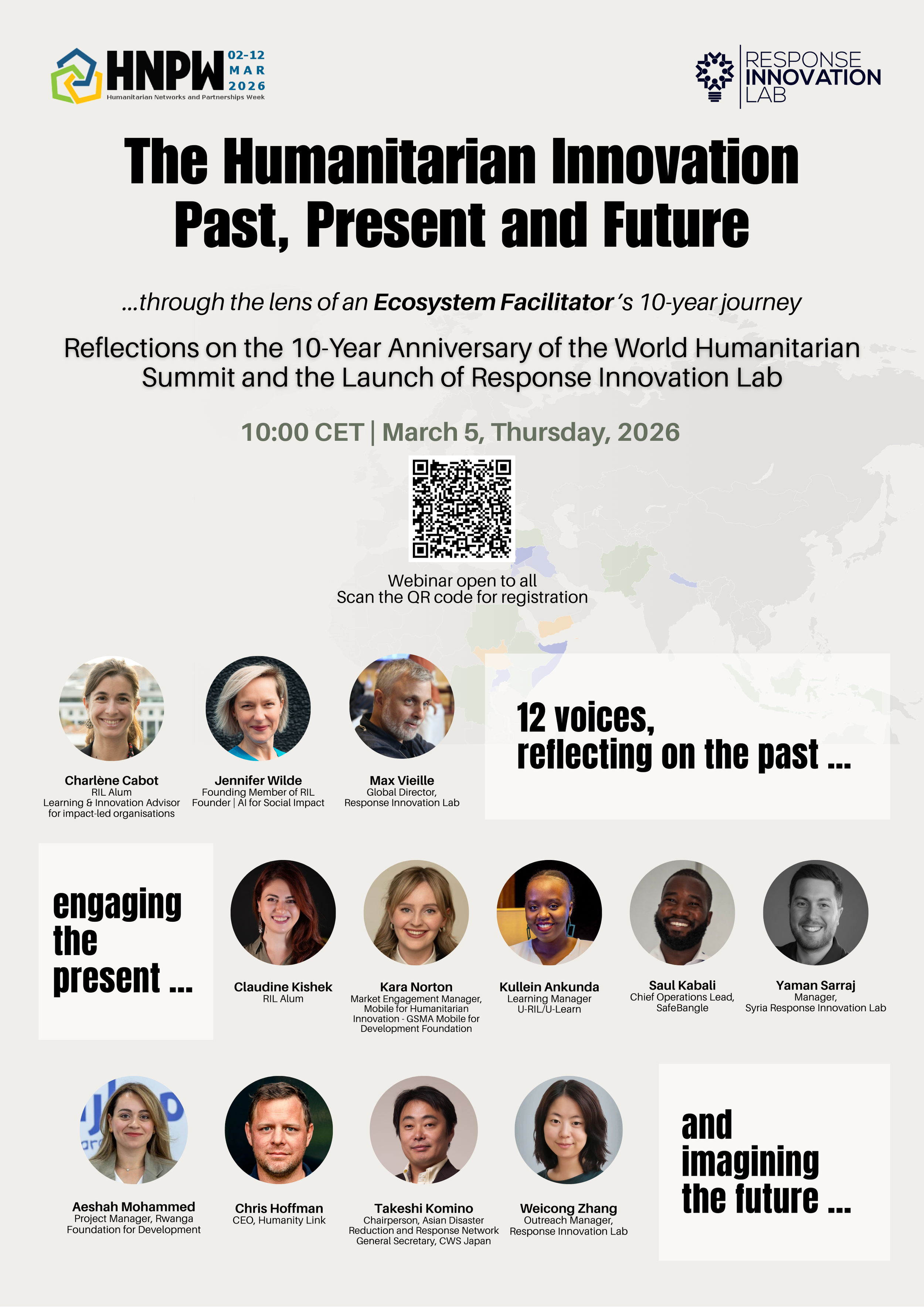
Watch the recording here.
120 mins, walking you through the evolution of humanitarian innovation throughout the past decade and the envisioning of the next decade and beyond.