
Insights from Uganda | Workshop on Humanitarian Research & Innovation Futures
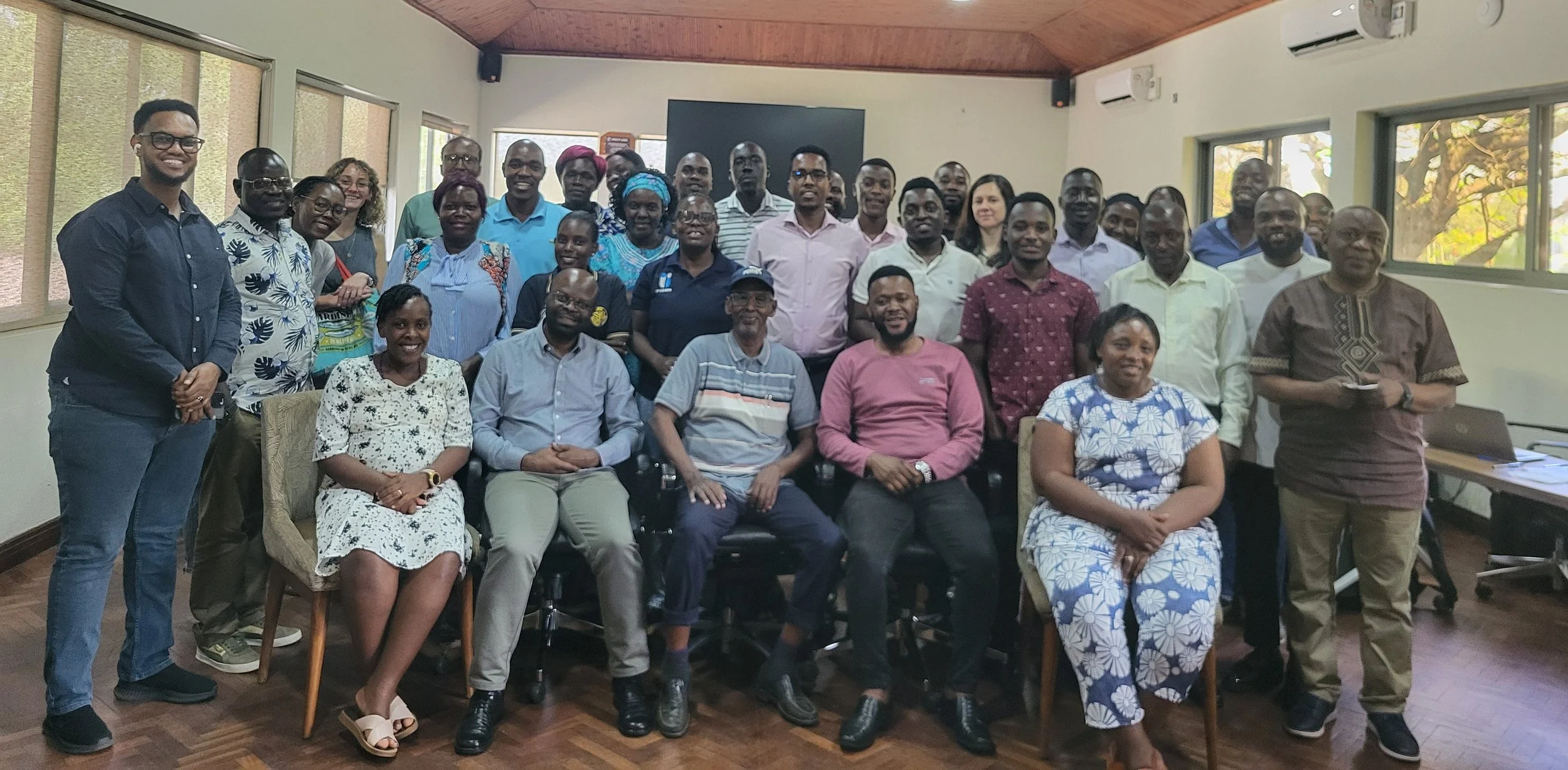
On November 27th, the Uganda Response Innovation Lab (U-RIL), in collaboration with Start Network, hosted a workshop focused on the future of research and innovation in humanitarian response across Uganda and its neighboring countries.
The event took place at the Fairway Hotel in Kampala and brought together a diverse group of participants, including refugee-led ecosystem support organizations, innovators, and researchers from Uganda, Somalia, South Sudan, and the Democratic Republic of Congo.
The participants utilized Elrha’s Humanitarian Research and Innovation Futures Toolkit designed to help humanitarian leaders and their teams make sense of uncertainty, explore systemic challenges, and generate actionable strategies for the future.
Workshop Background
Start Network’s Humanitarian Innovation Manager, Natasha Gue, provided the workshop background. She shared that the Innovation and Futures workshop brought together Start Network’s hubs from three countries together in Uganda to explore the country’s rich ecosystem, some doing community-led innovation and response and entrepreneurship. The participants visited different labs and innovations throughout their stay in Uganda. Throughout the week, the hubs from different countries were narrowing down on their priorities and what they would explore in their own contexts through their programs or innovations. The workshop also aimed to foster collaboration amongst the hubs. The workshop aimed to help participants explore how to think about innovation in the future and how to apply it to their work. The workshop also aimed to build confidence around using innovation methods and principles by demystifying innovation terms.
Creating A Futures-Informed Strategic Portfolio in 4 Steps
Elrha’s toolkit involves a four-step process through in which participants frame foresight questions in a systemic way, immerse themselves in plausible futures, generate sequenced action pathways, and test their ideas against potential impact. Workshop participants used the process as shown below:
Step 1: Choose and frame a foresight challenge
The purpose of this step is to focus foresight on the most strategically important and uncertainty-shaped challenges. Participants, who were divided into five groups, were given six challenges from the toolkit challenge menu to choose from. Participants were given stickers to vote for three challenges, and Challenge 2 received the most votes.
Challenge 2: In humanitarian response, credibility and legitimacy rest on the ability to adapt to changing needs and expectations of affected people. When innovation is deprioritised, agencies often fall back on tried-and-tested approaches that may no longer meet the realities on the ground. Decision makers may believe consistency builds trust, but failing to evolve quickly risks disconnecting from the communities they aim to serve.
We know from experience that aid that doesn’t evolve becomes less relevant, less dignified, and sometimes even harmful. Agencies that cannot innovate risk losing legitimacy and being bypassed by local actors or community-led solutions.
In practice, this manifests when affected communities' feedback channels reveal declining participation. There is also more competition from similar service providers. Younger, more agile local organisations begin filling the gap with approaches that feel more culturally appropriate and responsive.
Framing Question: How could declining innovation make our work less relevant to the people we serve?
Step 2: Living in the scenario
The purpose of this step is to immerse the team in a future scenario and explore how their chosen foresight challenge and foresight question appear in that world. This helps surface urgency, opportunity, and risk in different contexts. Find below an example from the participants:
Scenario name: Corporate Humanitarianism
Foresight question: How might we have positive projects in a future where lack of participation and inclusivity in innovation communities and reduced funding, so that we can avoid taking a long time adapting to the program/project and less community engagement?
Impact (how the challenge shows up): 1) Communities without purchasing power wait in the margins; 2) Legitimacy is measured in the consumer satisfaction scores rather than humanitarian principles; 3) Communities experience aid not as solidarity but as a commodity.
Opportunities: 1) Multinational corporations 2) Governments negotiate directly with corporations to secure bulk contracts; 3) Private actors audit their infrastructure and resources, decide priorities; 4) Not depending on humanitarian aid.
Risks: 1) Relief is fast for those who can afford it, dangerous absent for those who cannot; 2) Entire communities are outside the safety nets; 3) UN agencies no longer command operational influence
Step 3: Idea Generation
The purpose of this step is for participants to move from foresight insights into a concrete strategic action pathway. Participants capture short-term, medium-term, and long-term actions, then prioritise immediate steps. Find below an example:
Foresight question: How might we have positive projects in a future where lack of participation and inclusivity in innovation communities and reduced funding, so that we can avoid taking a long time adapting to the program/project and less community engagement?
Now (0-12 months, immediate action): Involvement of community leaders for buy-in; Community sensitization and training-of-trainers
Next (1-3 years, build and scale): Pre-testing and selecting appropriate innovations; MEAL; Roll out the project
Beyond (3+ years, bold transformation): Scale the innovation; Community resilience
Step 4 – Impact Wind-Tunnelling + Strategic Portfolio setting
The purpose of this step is to test ideas generated in Step 3 to see which are robust, which need adaptation, and which are risky, by comparing them against two impact dimensions:
1. Impact on the organisation’s resilience.
2. Impact on the lives of the people supported.
Each group selected an idea and did a visual presentation about the idea. Find below two examples:
Group 1: Community engagement
Starting from the national level including OPM and line ministries. For communities, getting feedback from households on solutions that are designed for them before implementation. Based on feedback from the communities, come up with learnings on how to implement the program or activities.
Group 2: Community-developed anticipatory mechanism
The vision in three years is for the communities they work with being able to create and implement their own anticipatory mechanism. This is hinged on a central communication system created and used by the community. It involves four steps:
1. Preparation: Strong knowledge management within the community and retention, tacit learning and its utilization. Communities learn their environment and know what to do in case of crises, leading to strong community preparedness frameworks. So when a disaster hits, they already know what to do.
2. Trigger: This is a clearly understood warning with a threshold made using indigenous/local knowledge, e.g. an oncoming flood in the next three days
3. Action: The community is strong enough and knows what to do about the trigger
4. Response
What did the participants say about the workshop?
“This workshop has helped me realise a new format of ideation, of coming up with different ideas and making them work for the community.”
“I have learnt that impact on the community depends on us [local actors]. It doesn’t come from outside.”
“The workshop has opened my eyes to know the challenges in the humanitarian system and to know how to diversify funding.”