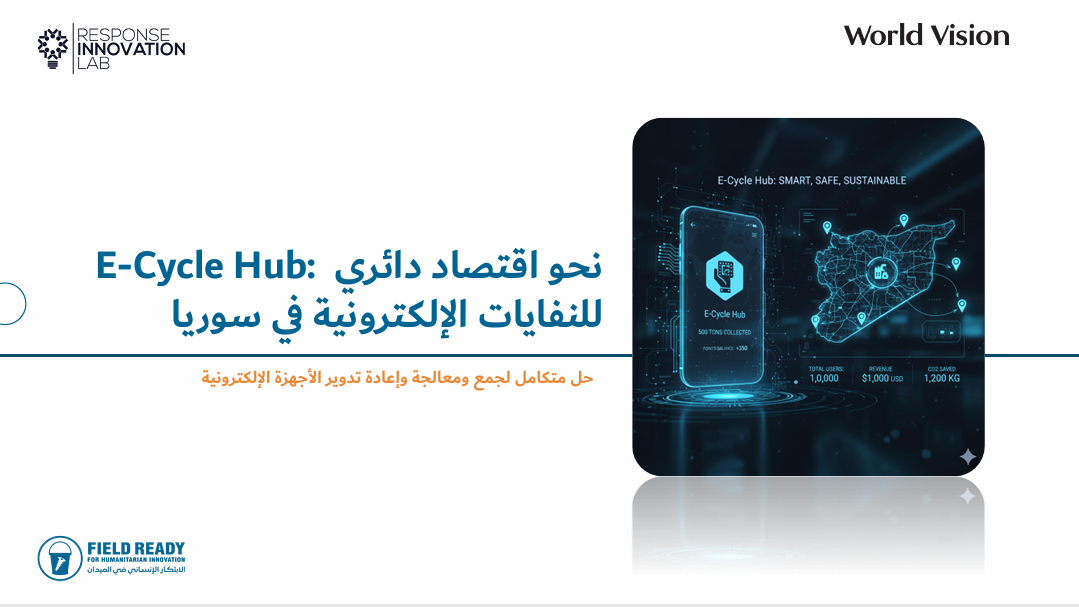
From Waste to Value: E-Waste Management Innovation in Syria
SyRIL, in partnership with Field Ready for Humanitarian Innovation and World Vision Syria Response, with generous support from World Vision Hong Kong, has launched a pioneering new initiative tackling E-Waste management in Aleppo. This project is designed to strengthen local capacities for sustainable e-waste management in Aleppo by empowering youth innovators to co-create and prototype two practical, context-appropriate solutions that address identified e-waste challenges and contribute to measurable environmental impact.
-
Northwest Syria faces growing environmental, economic, and public health risks related to unmanaged solid and electronic waste. The previous years of conflict have decimated critical infrastructure across cities and towns, generating vast quantities of damaged or obsolete electronic devices, from household products and medical equipment to communication systems, solar components, and old TVs and computers. The 2023 earthquake further compounded this crisis, destroying hospitals, schools, and public buildings, and contributing an additional surge of e-waste to an already fragile waste ecosystem. Most of this waste is now handled informally, if at all, without any structured system for collection, processing, or safe disposal.
According to the UN Common Country Analysis (CCA) 2024 for Syria, “solid and electronic waste management systems in Syria are either non-existent or highly fragmented” with informal disposal contributing significantly to soil and water contamination, especially in urban and peri-urban areas. The environmental risks posed by unmanaged e-waste are severe: hazardous substances such as lead, mercury, cadmium, and flame retardants are released into the environment through unsafe practices like open burning and unprotected dismantling. These substances contaminate the air, soil, and water, posing serious threats to human health and ecological systems, especially in densely populated or vulnerable areas. The report emphasizes the urgent need for environmentally sound waste practices, youth engagement, and locally-driven innovation to address these interconnected challenges.
Humanitarian and development actors working in post-conflict Syria have observed a growing trend of informal e-waste reuse and resale, often driven by individuals and local repair shops as a source of income. However, these practices are unregulated, unsafe, and inefficient, lacking the necessary standards for environmental protection, public health, and scalability. There is increasing consensus across humanitarian and academic sectors that the way forward lies in structured aggregation mechanisms, localized recycling models, and stronger coordination among universities, NGOs, and the private sector. Through leveraging local facilities and introducing circular economy approaches, Syria can begin transforming waste into valuable resources, supporting both environmental sustainability and economic recovery.
-
The SyRIL has funded this project, and provided its tools and approach which was adapted by the local partner Field Ready.
-
The project aiims to strengthen local capacities for sustainable e-waste management in Aleppo by empowering youth innovators to co-create and prototype two practical, context-appropriate solutions that address identified e-waste challenges and contribute to measurable environmental impact.
-
The project followed an Innovation process cycle, with the following steps:
Conducted an e-waste ecosystem mapping exercise covering main stakeholders, including non-traditional ones such as e-waste generators, electronics repair and maintenance workshop owners, and waste collectors.
Organized a convener focused on mapping the challenges around e-waste management in Aleppo.
Launched a call for innovative solutions to address the identified root causes, targeting 20 youth innovators.
Provided participating teams with design thinking training to support them in shaping and refining their projects.
Co-designed 6 solutions and organized a pitching day to support the development of prototypes for the top 2 solutions.
Provided seed funding of $9,000 for first place and $6,000 for second place.
Supported the teams through a structured mentoring program.
Showcased the results at a formal workshop attended by key stakeholders from the e-waste management ecosystem.
The project also supported the development of a practical, evidence-based guidance paper on e-waste management, covering aggregation mechanisms and recycling/upcycling approaches drawn from regional and global experiences, which was disseminated to a broad audience of humanitarian, academic, private sector, and local stakeholders through a public showcase event held in Aleppo to promote replication and inform future e-waste efforts in post-conflict Syria.
-
You can find the following resources as part of the Project, accessible to all:
A technical research paper on E-Waste Management in Aleppo (available in both English & Arabic)
Stay tuned for more!
The winning teams!
Click on the pictures to learn more!